If there is a single dish that defines Persian home cooking, it is Ghormeh Sabzi — a slow-cooked herb and lamb stew that has been simmering in Persian kitchens for at least 500 years. The name translates literally as “cooked greens,” and that description barely hints at the depth of flavor produced when fresh herbs, dried Persian limes, and tender meat slow-cook together over several hours. The result is a stew that is earthy, tangy, deeply savory, and unlike anything else in world cuisine.
At FandoQ in Westbury, NY, Ghormeh Sabzi is one of our most beloved dishes — and a perennial favorite for anyone exploring Persian cuisine for the first time. This recipe guide explains the technique, the ingredients, and the cultural context that makes this stew worth every hour of cooking time. You can also read about Ghormeh Sabzi and Tahdig together on our blog.
The History of Ghormeh Sabzi
Food historians trace Ghormeh Sabzi back at least to the Safavid era (1501-1736), when Persian court cuisine reached its height of sophistication. The dish likely predates that by centuries — dried limes, the stew’s defining ingredient, were a Persian Gulf trade commodity used in Persian cooking long before formal documentation. The combination of sautéed herbs, dried limes, and kidney beans with meat appears in medieval Persian cookbooks and has remained essentially unchanged.
In modern Persia, Ghormeh Sabzi is considered the national dish by popular consensus. It appears at every important family gathering, every Persian New Year table, and every significant meal. Persians living abroad — in Los Angeles, London, Toronto, and now Westbury, NY — speak of it with a particular nostalgia that no other dish quite matches. The smell of fenugreek and dried lime hitting a hot pan is, for many Persians, the smell of home.
The Essential Ingredient: Dried Persian Lime
Dried limes (limu omani or loomi) are whole limes that have been sun-dried until they become hard, hollow, and dark inside. They have a concentrated, intensely tangy, slightly smoky, almost fermented flavor that is unique in world cuisine — there is genuinely no substitute. You can find them at Middle Eastern grocery stores, Persian markets, and increasingly online.
For Ghormeh Sabzi, dried limes are pierced with a skewer or knife (so their flavor can seep into the stew) and added whole during cooking. The longer they cook, the more flavor they release. Some cooks add 3-4 limes; others add 6-8 for more intensity. Taste as you go.
Ingredients
Serves 4-6
- 600g (1.3 lb) lamb shoulder or boneless leg, cut into 3cm cubes (beef chuck also works)
- 1 large onion, finely diced
- ½ tsp ground turmeric
- 400g (14 oz) can kidney beans, drained (or 200g dried, soaked and boiled)
- 4-6 dried Persian limes, pierced
- 3 tbsp oil
- Salt and pepper to taste
The herb mixture (the heart of the dish):
- 200g (7 oz) flat-leaf parsley, finely chopped
- 150g (5 oz) fresh fenugreek leaves (or 3 tbsp dried fenugreek / methi)
- 100g (3.5 oz) chives or spring onion greens, finely chopped
- 50g (1.7 oz) fresh coriander / cilantro (optional but recommended)
Step-by-Step Instructions
Step 1: Sauté and Dry the Herbs
This step is what separates a good Ghormeh Sabzi from a transcendent one. Heat 2 tbsp oil in a large, heavy skillet over medium heat. Add all the chopped herbs and cook, stirring frequently, for 20-30 minutes until the herbs are deeply darkened, almost dry, and fragrant. They will reduce dramatically in volume. You are not burning them — you are caramelizing their natural sugars and concentrating their chlorophyll-rich flavor. The herbs should look nearly black and smell intensely aromatic. Set aside.
Step 2: Brown the Meat
In a large, heavy pot (Dutch oven ideal), heat 1 tbsp oil over high heat. Season lamb with salt and pepper. Brown in batches — do not crowd the pan — until deeply caramelized on all sides, 4-5 minutes per batch. Set aside.
Step 3: Build the Base
In the same pot, add the diced onion and cook over medium heat until soft and golden, 10-12 minutes. Add turmeric and stir 1 minute. Return the browned meat to the pot.
Step 4: Add Herbs, Limes, and Liquid
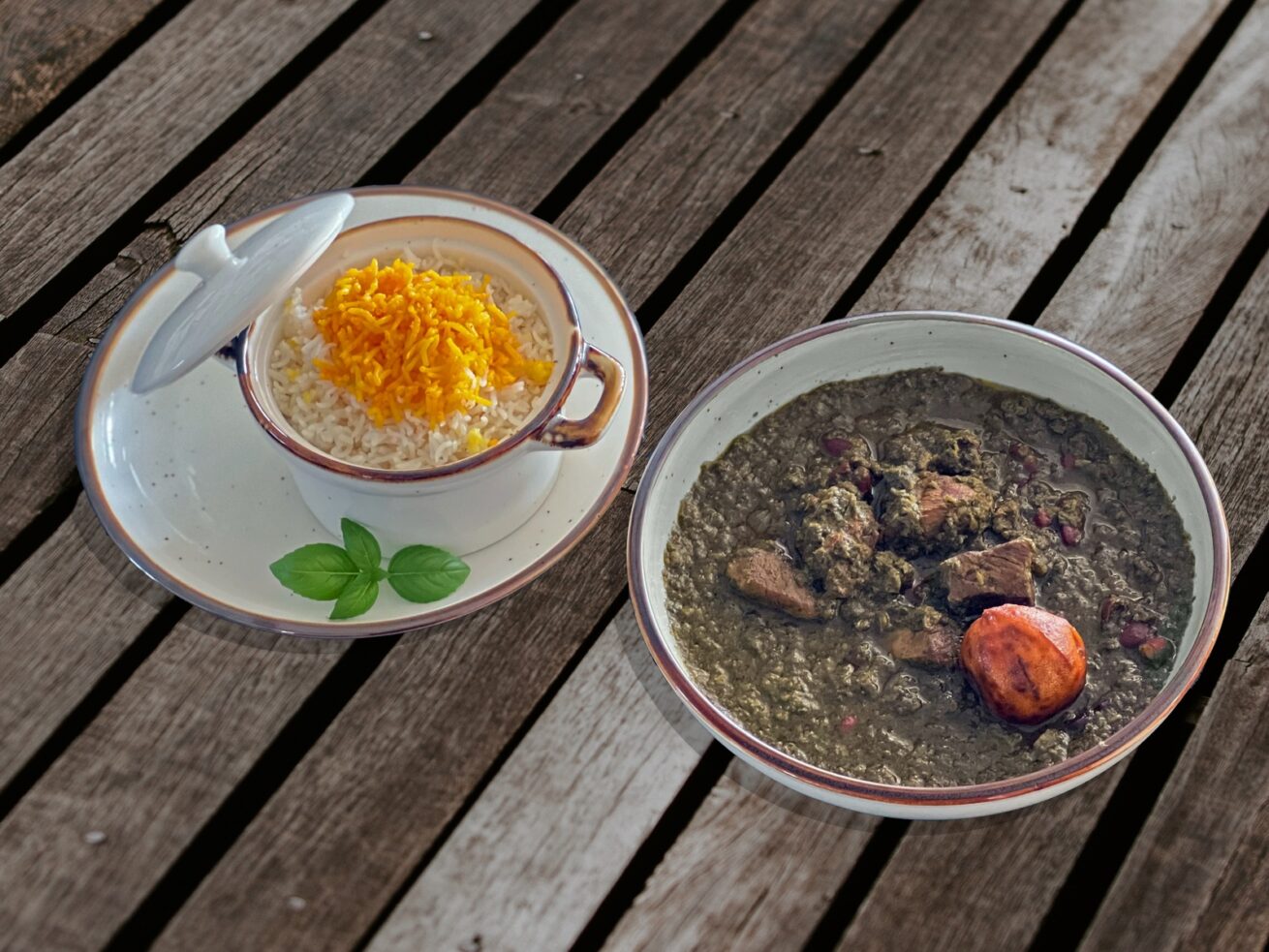
Add the sautéed herb mixture to the pot along with the pierced dried limes and kidney beans. Add enough water or light broth to just cover (about 500ml). Bring to a boil, then reduce to a very gentle simmer. Cover and cook for 90 minutes to 2 hours, stirring occasionally. The meat should become completely tender and the stew should thicken and darken to a deep, almost khaki-green color.
Step 5: Season and Rest
Taste and adjust salt. The stew should be intensely savory with a distinctive tangy note from the dried limes. If you want more tartness, press the dried limes gently against the side of the pot to release more of their interior. Remove limes before serving (they are too intensely sour to eat whole). Let the stew rest 15-20 minutes off heat before serving — like most braises, Ghormeh Sabzi always tastes better after resting.
Serving Ghormeh Sabzi
Ghormeh Sabzi is always served over saffron rice with tahdig. The stew’s dark, herb-forward sauce soaks into the fluffy grains while the crispy tahdig provides the textural contrast that makes every bite interesting. At the table, offer additional fresh herbs, raw onion, and pickles (torshi) as accompaniments.
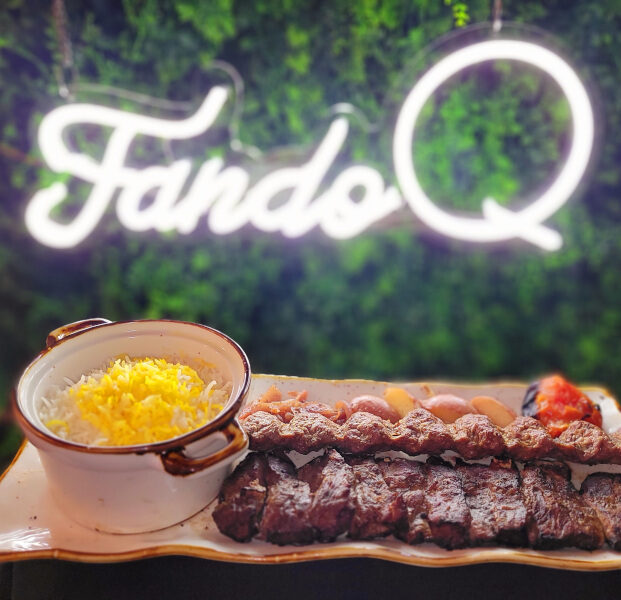
At FandoQ in Westbury, NY, our Ghormeh Sabzi is slow-cooked in our kitchen using the same technique described here. You can find it on our main courses menu, served with fragrant saffron rice and alongside the full breadth of our Persian and Mediterranean offerings.
Storing and Reheating
Ghormeh Sabzi improves significantly with time — the flavors meld and deepen overnight. It keeps refrigerated for 4-5 days and freezes beautifully for up to 3 months. Reheat gently with a splash of water to loosen. Many Persian cooks deliberately make Ghormeh Sabzi a day ahead for this reason: the second-day version is almost always richer and more fully integrated than the first.