
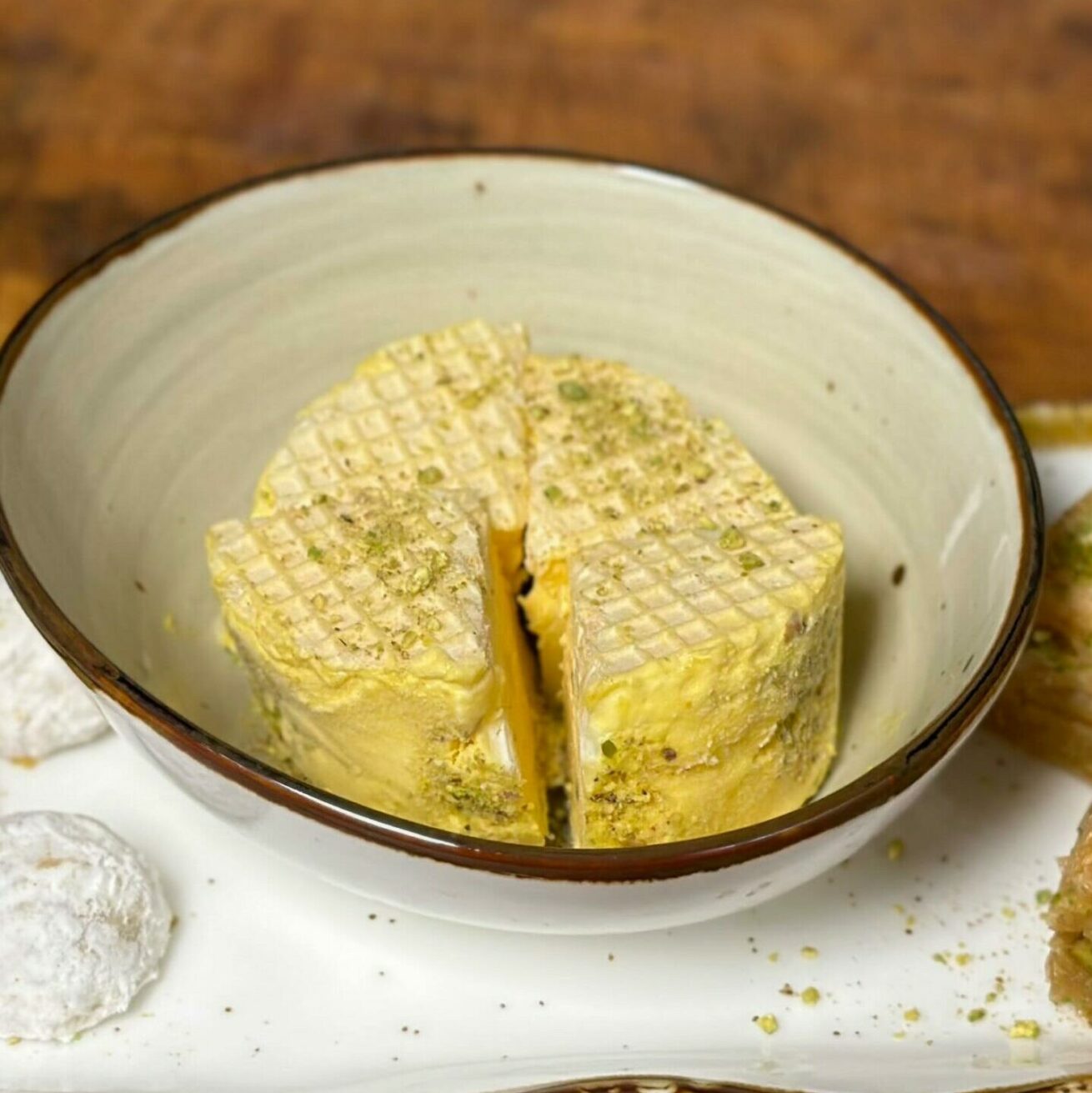
Bastani Sonnati — “traditional ice cream” in Farsi — is Persia’s most beloved frozen dessert: a dense, perfumed ice cream flavored with saffron, rose water, and shredded frozen cream, studded with chopped pistachios, and with a texture unlike any Western ice cream you have encountered. It is rich without being heavy, aromatic without being overwhelming, and unmistakably Persian in every sense.
At FandoQ in Westbury, NY, our Persian saffron ice cream is one of our most-requested desserts — a proper close to a Persian meal that guests remember long after the kebabs. This recipe explains how to make it at home, with the techniques that produce the authentic texture and flavor. See our full dessert selection for the full range of what we offer in Westbury.
The History of Bastani in Persian Culture
Ice cream in Persia predates the European version by centuries. The Persian tradition of sharbat — chilled, sweetened, flavored beverages and frozen desserts — traces back to at least the Achaemenid Empire, when mountain ice was transported to palace kitchens to produce chilled treats for the court. Bastani as it is known today emerged during the Qajar dynasty (19th century), when the combination of saffron, rose water, and cream became the definitive flavor profile.
In traditional bastani, a key textural element comes from salep — a starch derived from wild orchid tubers, used in Turkish and Persian cooking as a thickener that gives ice cream a stretchy, dense, chewing-gum-like quality. Authentic salep is rare and expensive; this recipe uses a combination of cornstarch and heavy cream to approximate the texture at home.
The other signature element is shredded frozen cream (khame) — flakes of frozen heavy cream that are folded into the ice cream during the last stages of churning, creating visible white veins of pure dairy richness throughout the finished scoop. This is the detail that distinguishes bastani from a simple saffron ice cream.
On Saffron Quality
This recipe lives or dies by saffron quality. Good saffron — fresh, from Persia, Spain, or Kashmir — will bloom in hot water within minutes into a vivid, jewel-bright orange-gold with a distinctive floral, slightly metallic fragrance. Poor saffron produces dull yellow color and flat flavor. For bastani, use the best saffron you can find. You need relatively little by weight, but quality is essential.
Ingredients
Makes approximately 1 litre (8 servings)
- 500ml (2 cups) whole milk
- 250ml (1 cup) heavy cream, plus 100ml extra for the frozen cream flakes
- 150g (¾ cup) sugar
- 2 tbsp cornstarch
- ½ tsp high-quality saffron threads, ground to powder
- 4 tbsp rose water (use Persian or Turkish rose water — not essence)
- 100g (¾ cup) raw pistachios, roughly chopped
- 1 tsp vanilla extract (optional)
Step-by-Step Instructions
Step 1: Bloom the Saffron
Grind saffron threads to a fine powder using a mortar and pestle. Dissolve in 3 tbsp of the warm milk and steep for 15 minutes until the liquid turns deep, vivid gold. This blooming step extracts the maximum color and flavor — do not skip it or rush it.
Step 2: Make the Custard Base
Whisk the cornstarch with ¼ cup of the cold milk until completely smooth and lump-free. In a medium saucepan, combine the remaining milk, 250ml cream, and sugar. Heat over medium heat, stirring, until the sugar dissolves. Add the cornstarch slurry and the bloomed saffron liquid. Continue heating, stirring constantly, until the mixture thickens enough to coat the back of a spoon (about 10-12 minutes). Do not boil vigorously.
Step 3: Add Rose Water
Remove from heat and stir in the rose water and vanilla (if using). Rose water is volatile — adding it off-heat preserves its delicate floral character. Taste the mixture: it should be fragrant, distinctly rose-forward, and golden. Let cool to room temperature, then refrigerate until completely cold (minimum 4 hours, ideally overnight).
Step 4: Freeze the Cream Flakes
Pour the extra 100ml heavy cream into a shallow, flat container or baking sheet lined with plastic wrap. Freeze until solid (1-2 hours). Once frozen, use a fork to scrape it into coarse flakes. Keep frozen until the last step.
Step 5: Churn
Churn the cold custard in an ice cream maker according to the manufacturer’s instructions (typically 20-25 minutes). When the ice cream reaches soft-serve consistency — thick, creamy, and cold — add the chopped pistachios and churn for 1 more minute to distribute.
Step 6: Fold in the Cream Flakes
Transfer the churned ice cream to a freezer-safe container. Working quickly, fold in the frozen cream flakes with a spatula — you want them to remain as visible white veins, not fully incorporated. Smooth the top, press plastic wrap directly onto the surface, and freeze for at least 4 hours until firm.
No ice cream maker? Pour the cold custard into a shallow metal pan and freeze. Every 30-45 minutes for the first 3 hours, scrape and stir the edges toward the center with a fork, breaking up ice crystals. Fold in cream flakes and pistachios during the last stir before the final freeze.
Serving Bastani the Persian Way
In Persia, bastani is traditionally served between two thin wafers (noon-e bastani) as an ice cream sandwich, or scooped into a bowl and eaten with a spoon alongside a glass of faloodeh (saffron rose water sorbet with vermicelli noodles). At home, scooping into chilled bowls with extra pistachios on top is perfectly traditional.
Bastani pairs wonderfully with Persian pastries, baklava, or simply as the finale to a large Persian meal. At FandoQ, we serve it alongside our Chocolate Mousse Cake and other desserts as part of a complete Persian Mediterranean experience in Westbury, NY.
Storage
Bastani keeps well in the freezer for up to 2 weeks. Because it contains rose water and no artificial stabilizers, it freezes firmer than commercial ice cream — remove it from the freezer 5-10 minutes before scooping to allow it to soften slightly. The flavor actually deepens over the first 24-48 hours as the saffron and rose water continue to meld.