For millions of Muslims living in the New York metropolitan area, finding restaurants that serve properly prepared halal food is not a preference — it is a fundamental daily need. On Long Island, where a significant and growing Muslim population makes Nassau and Suffolk Counties their home, the demand for authentic halal dining has never been higher. Yet the options remain surprisingly limited — and the quality more so.
This guide is for anyone who wants to understand what halal means, why it matters, and where to find genuinely excellent halal food on Long Island. Whether you are Muslim and seeking trustworthy options near Westbury, or simply curious about what the halal standard actually involves, this is the resource you need.
What Does Halal Mean?
“Halal” (حلال) is an Arabic term meaning “permissible” under Islamic law. In the context of food, it refers to a comprehensive set of requirements governing how animals are raised, slaughtered, and prepared for consumption. Halal encompasses far more than simply “no pork” — it is a complete framework covering every stage of food production, from farm to table.
The Dhabiha Slaughter Process
The Islamic method of animal slaughter is called dhabiha (ذبيحة). To qualify as halal, the slaughter must:
- Be performed by a Muslim of sound mind and sincere intention
- Invoke the name of God (Bismillah, Allahu Akbar) at the moment of slaughter
- Use a sharp, clean blade in a single swift cut across the jugular vein, carotid arteries, and windpipe
- Allow blood to drain completely from the carcass before processing
The requirement for complete blood drainage is both spiritual and practical. Blood is considered haram (forbidden) under Islamic dietary law, and thorough drainage also reduces bacterial contamination and can improve meat quality. Many food scientists have observed that properly performed dhabiha produces consistently high-quality results for exactly this reason.
What Is Forbidden (Haram)
Beyond slaughter method, Islamic dietary law prohibits:
- Pork and all pork derivatives — including lard, gelatin derived from pork, and many food additives sourced from pork
- Blood and blood products
- Alcohol in any form — including food cooked in wine or spirits
- Improperly slaughtered animals — including those that died before slaughter
- Carnivorous animals and birds of prey
- Any food contaminated by the above during preparation, even through shared cookware or fryer oil
This means halal certification is not merely about the meat — it encompasses the entire preparation environment, the sauces, the marinades, and even the oil in which food is fried. A restaurant that fries pork items in the same oil as chicken cannot legitimately claim its chicken is halal.
Why Halal Dining Matters on Long Island
Long Island’s Muslim population has grown substantially over the past two decades. Nassau and Suffolk Counties are home to large communities from South Asia (Pakistan, Bangladesh, India), the Arab world (Egypt, Yemen, Palestine), and West Africa — communities for whom halal food is not optional. For these residents, finding reliable halal restaurants is as fundamental a community need as a school or a pharmacy.
Beyond observant Muslim consumers, halal food has also gained wider mainstream interest among non-Muslim diners who associate it with higher animal welfare standards, cleaner processing, and ethical sourcing practices that parallel growing interest in kosher and organic food. The transparency required for halal certification aligns with a broader consumer trend toward knowing where food comes from and how it was produced.
The result is that Long Island’s halal restaurant scene serves a diverse audience: observant Muslims who require it, secular Muslims who prefer it, and non-Muslim diners who appreciate the quality and integrity that genuine halal preparation reflects.
What to Look for in a Halal Restaurant
Not all restaurants that describe themselves as halal maintain the same standards. Here is how to evaluate a halal dining option on Long Island:
Certification: The most reliable indicator is certification from a recognized organization — such as the Islamic Food and Nutrition Council of America (IFANCA) or a local mosque certification body. Ask whether the restaurant is certified and by whom. Legitimate halal restaurants welcome this question.
Fully halal vs. halal options: A restaurant that serves pork or non-halal items alongside halal dishes — using shared preparation equipment — may inadvertently compromise its halal food through cross-contamination. A fully halal restaurant, where nothing non-halal enters the kitchen, is the safest choice.
Transparency about sourcing: A trustworthy halal restaurant knows where its meat comes from and is happy to say so. Evasiveness about sourcing is a warning sign.
Halal Dining on Long Island: Where to Eat
FandoQ — Westbury, NY (Persian Mediterranean Halal)
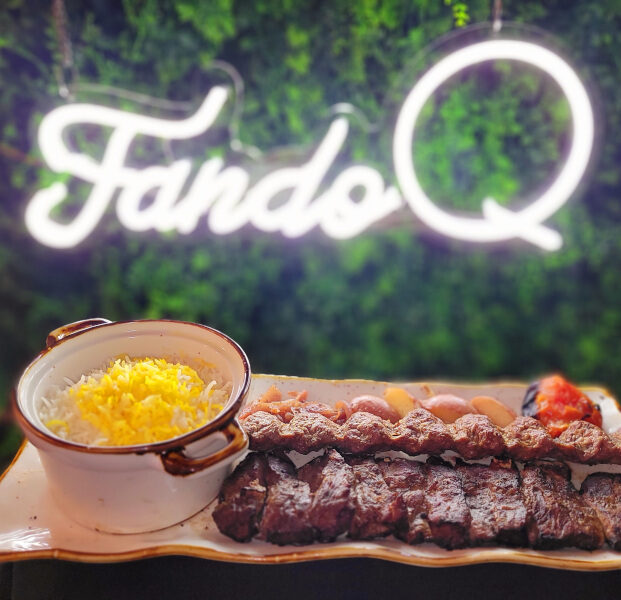
For Persian Mediterranean halal cuisine on Long Island, FandoQ at 1610 Old Country Rd, Westbury, NY is the premier destination. All meat served at FandoQ is halal-certified, and the restaurant is fully halal — there are no non-halal items on the menu and no risk of cross-contamination.
What makes FandoQ exceptional beyond its halal credentials is the quality and authenticity of the food itself. Persian cuisine — built around saffron, dried limes, fresh herbs, slow-cooked stews, and expertly grilled kebabs — is one of the world’s great culinary traditions, and FandoQ executes it with genuine craft. The menu spans:
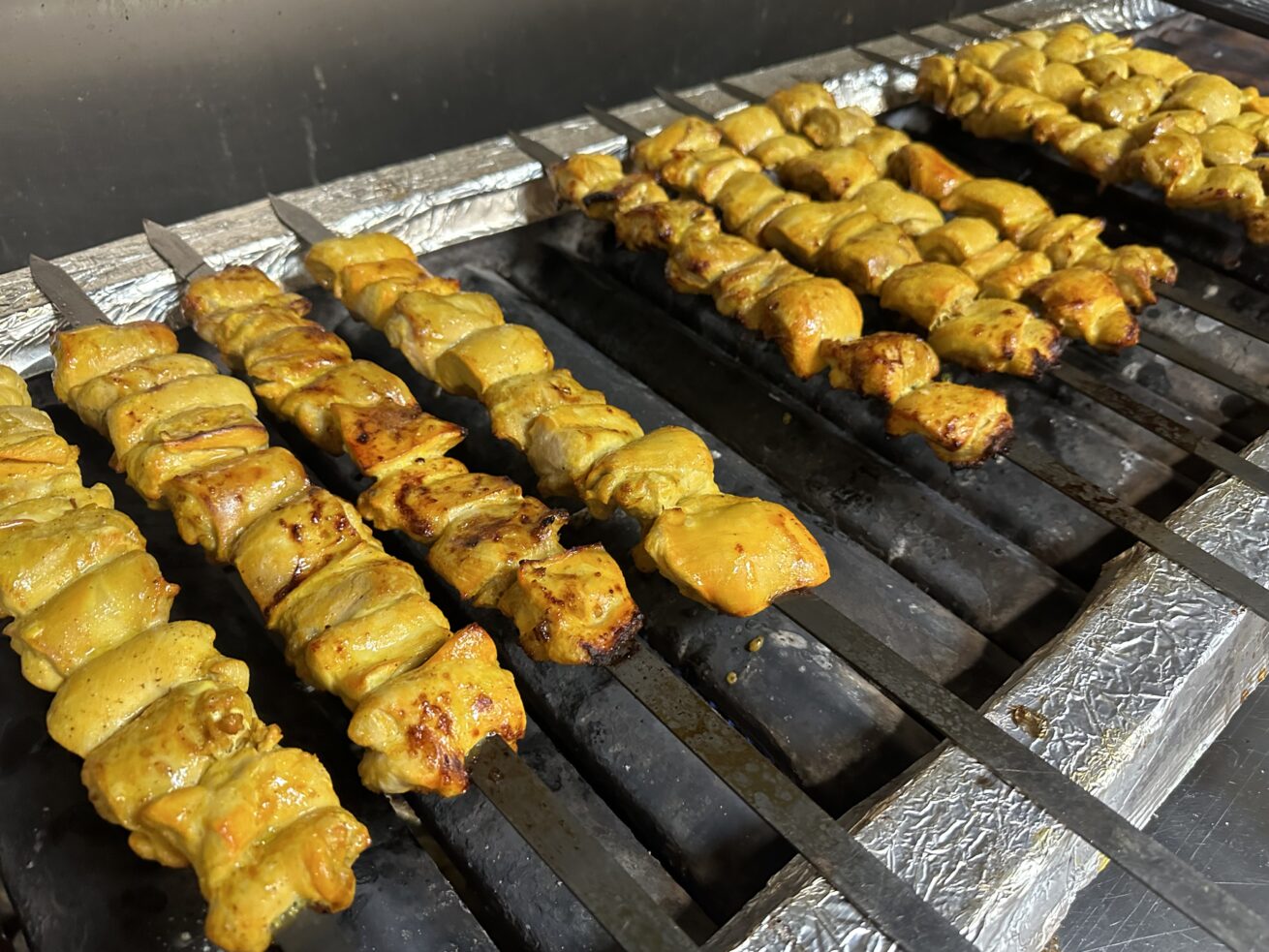
- Signature kebabs — Kubideh, Barg (filet), Juje (saffron chicken), Shrimp, Salmon, and Lamb Shish Kebab, all grilled over high heat with authentic Persian marination
- Persian stews — Ghormeh Sabzi (herb and dried lime stew) and Gheymeh (tomato and split pea stew), slow-cooked to authentic depth
- Rice dishes — saffron basmati with crispy Tahdig, Zereshk Polo (barberry rice), and Albaloo Polo (sour cherry rice)
- Appetizers — Hummus, Falafel, Kashk-e-Bademjan, Grape Leaves Dolmeh, Mast Dip
- Desserts — Persian saffron ice cream, Baklava, and Chocolate Mousse Cake
FandoQ is located at 1610 Old Country Rd, Westbury, NY 11590. Hours: Monday–Thursday 3:00 PM–9:00 PM | Friday–Saturday 1:00 PM–10:00 PM | Sunday 1:00 PM–9:00 PM. Call (516) 279-4551 to reserve.
FandoQ is an excellent choice for non-Muslim diners as well — the food is universally excellent, and the halal certification simply reflects the restaurant’s commitment to quality, ethical sourcing, and authentic Persian tradition.
Other Halal Options on Long Island
Long Island has other halal dining options scattered across communities with large Muslim populations — particularly in Hempstead, Elmont, Hicksville, and parts of the East End. South Asian halal restaurants (Pakistani, Bangladeshi, Indian) and Middle Eastern spots serve their local communities well. For a community-verified directory of halal restaurants across Long Island and the New York metro area, Zabihah.com is the most comprehensive resource available — it lists certified halal restaurants with community reviews and verification status.
Common Questions About Halal Food
Is halal food only for Muslims?
No. Halal food is produced according to Islamic dietary standards but can be eaten by anyone. Many non-Muslim consumers actively seek halal meat for its processing standards, ethical production practices, and the assurance of quality that certified halal represents.
Is halal the same as kosher?
They share principles — both prohibit pork and blood, both require specific slaughter methods — but differ significantly in details. Kosher law prohibits mixing meat and dairy; halal does not. The slaughter techniques differ. Kosher certification does not make food halal, and vice versa — though some Orthodox Jews accept halal beef in regions where certified kosher is unavailable.
Is halal meat more expensive?
Properly certified halal meat may carry a slight premium due to certification costs and sourcing requirements. At a restaurant like FandoQ, this is reflected in a premium dining experience — the quality of the ingredient is inseparable from the quality of the finished dish.
How do I know if a restaurant is genuinely halal?
Ask for their certification body and certificate number. Check community directories like Zabihah.com. Look for a halal certificate displayed in the restaurant. At FandoQ, we are proud to be transparent about our halal sourcing and welcome any questions from guests.
The Nutritional Benefits of Halal Cuisine
Beyond religious compliance, halal food offers documented nutritional benefits. The requirement for thorough blood drainage results in lower residual iron in the meat — which can be beneficial for people managing certain health conditions. The prohibition on alcohol means halal dishes are never cooked in wine or spirits. The emphasis on fresh herbs, lean meats, and vegetable-forward cooking in Persian and Mediterranean halal cuisine aligns well with contemporary nutritional science.
You can read more about the nutritional benefits of halal food and explore what makes halal dining at FandoQ a uniquely satisfying experience in our blog.
Visit FandoQ — Long Island’s Halal Persian Mediterranean Restaurant
If you are searching for halal restaurants near Westbury or Nassau County, FandoQ is the answer you have been looking for. Our commitment to halal preparation is inseparable from our commitment to authentic Persian Mediterranean cuisine — both reflect the same values of quality, integrity, and care that we bring to every dish we serve.
We are located at 1610 Old Country Rd, Westbury, NY 11590. Call us at (516) 279-4551 or reserve online. We look forward to welcoming you to our table.