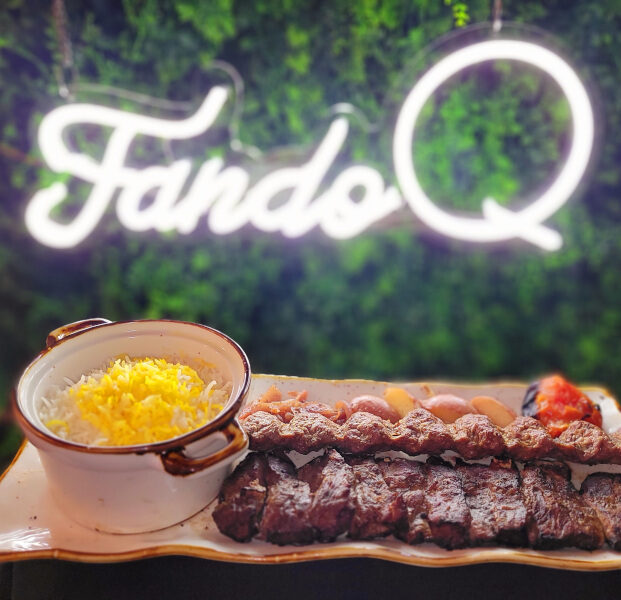
Each year, as the Earth crosses the spring equinox and the sun enters the astrological sign of Aries, more than 300 million people across Persia, Afghanistan, Azerbaijan, Central Asia, and Persian diaspora communities worldwide celebrate Nowrouz — the Persian New Year. At FandoQ in Westbury, NY, Nowrouz is the most joyful moment of our year: the season when the Long Island Persian community comes together, tables are set with symbolic abundance, and the air smells of fresh herbs and saffron.
The Astronomical Origins of Nowrouz
Nowrouz means “new day” in Farsi (now = new, rouz = day). It is celebrated at the precise astronomical moment of the vernal equinox — when day and night are exactly equal and spring officially begins. This moment, called the tahvil, is announced on Persian television and radio with the exact hour, minute, and second, and families gather around the Haft-Seen table at that precise moment to welcome the new year.
The precision of Nowrouz reflects its ancient astronomical foundation. Persian scholars and astronomers — including Omar Khayyam, who reformed the Persian calendar — calculated the solar year with extraordinary accuracy. The Persian Solar Hijri calendar that tracks Nowrouz is, by many measures, the most accurate solar calendar in the world. The celebration is not a myth or a belief; it is a fact of astronomy: spring begins, and with it, the new year.
Zoroastrian Roots: Nowrouz as a Sacred Day
Nowrouz predates Islam by more than 1,500 years. In Zoroastrianism, the ancient religion of Persia, the spring equinox was the day of creation — the moment when Ahura Mazda, the supreme deity of light, first created the world. It was also the first day that Zoroaster himself received his divine revelations, according to tradition.
The Achaemenid kings — Cyrus, Darius, Xerxes — celebrated Nowrouz with grand ceremonies at Persepolis. Delegations from across the empire brought gifts; the king received them in the Apadana hall, whose carved relief panels show subjects in festive procession. Nowrouz was both a religious and a political act: an affirmation of Persian civilization’s continuity and cosmic order.
When Islam arrived in Persia in the 7th century CE, Nowrouz was not extinguished — it was preserved as a cultural rather than religious celebration, continuing under Arab, Mongol, and Turkic rulers alike. It has survived 2,500 years of conquest, conversion, revolution, and diaspora because it is embedded in the Persian identity at a level deeper than any single faith or government.
The Haft-Seen Table: Seven Symbols of Spring
The centerpiece of every Nowrouz celebration is the Haft-Seen — a ceremonial table set with seven items whose names begin with the Persian letter seen (س). Each item carries a specific symbolic meaning tied to the blessings of the new year:
- Sabzeh (سبزه) — Wheat or lentil sprouts: Symbolize renewal and rebirth. Seeds are planted in a dish 2-3 weeks before Nowrouz; by the new year, they have grown into a small, green, living garden. On the 13th day (Sizdah Bedar), the sprouts are traditionally taken outdoors and thrown into running water, taking away the old year’s bad luck.
- Samanu (سمنو) — Sweet wheat germ pudding: Represents affluence and power. Making samanu is a communal women’s ritual — it is cooked overnight while participants sing traditional songs. The pudding takes many hours of stirring and is considered an act of devotion.
- Seeb (سیب) — Apple: Represents health and beauty. The red apple is one of the most ancient symbols of Persian beauty ideals.
- Senjed (سنجد) — Dried lotus berries: Represent love and affection. The sweet, date-like fruit is said to evoke the feelings of the heart.
- Seer (سیر) — Garlic: Represents medicine and good health. Garlic has been used in Persian folk medicine for millennia.
- Somagh (سماق) — Sumac: Represents the color of sunrise and the triumph of good over evil. Sumac’s deep red echoes the rising sun’s first light — a deeply Zoroastrian symbol.
- Serkeh (سرکه) — Vinegar: Represents patience and wisdom. Age improves vinegar, as it improves the human spirit.
In addition to the seven seen items, most families also add: a mirror (representing honesty and clarity), candles (representing light and wisdom), painted eggs (fertility), a goldfish in a bowl (life and the new zodiac cycle), a holy book, and a poetry collection — usually Hafez or the Shahnameh. The Haft-Seen table is set up days before Nowrouz and remains in place for the full 13-day celebration.
The 13-Day Celebration
Nowrouz is not a single day — it is a 13-day festival that resets the entire social and spiritual calendar:
Days 1-3: The first days of the new year are spent visiting family in a strict hierarchical order — elders first, then parents, then extended family, then friends. These visits, called did-o-bazdid, involve exchanging gifts, sharing sweets, and receiving eidi (new year’s money, given to children in crisp new bills). New clothes are worn; houses are freshly cleaned.
Days 4-12: Visits continue at a slower pace. Nowrouz is also a school holiday in Persia; businesses often operate at reduced capacity during this period. Persian music fills the air; families gather around tables laden with ajil (mixed nuts and dried fruits) and the season’s sweets.
Day 13 — Sizdah Bedar (سیزده بدر): The 13th day is considered unlucky if spent indoors, so by tradition everyone goes outside. Families picnic in parks, by rivers, or in open fields — sizdah bedar literally means “thirteenth out-of-doors.” The Sabzeh from the Haft-Seen table is thrown into running water on this day, symbolically releasing the old year’s misfortunes. Young unmarried women tie the Sabzeh into a knot and make a wish for marriage in the coming year. It is one of the most joyful days of the Persian calendar — playful, outdoor, communal, and full of food.
Traditional Nowrouz Foods
Nowrouz has a specific culinary tradition associated with the New Year’s table:
Sabzi Polo ba Mahi (سبزی پلو با ماهی): The definitive Nowrouz dish — herbed rice with fish. The green of the herb rice (sabzi polo) represents the rebirth of spring; the fish represents life and forward movement. This is the dish served at the exact moment of tahvil (the equinox), making it the most ceremonially significant food of the Persian year. At FandoQ, our fish dishes honor this tradition.
Reshteh Polo (رشته پلو) — Noodle Rice: Noodles in Persian culinary tradition represent the threads of life and destiny. Eating noodles on or around Nowrouz is said to bring good fortune and smooth the path ahead.
Ash Reshteh (آش رشته) — Herb and Noodle Soup: A thick, hearty soup with noodles, herbs, legumes, and kashk (dried whey), often served before or during the Nowrouz celebrations. It is one of Persia’s oldest and most beloved dishes — a bowl of protection, generosity, and luck.
Kuku Sabzi (کوکو سبزی) — Herb Frittata: A dense, green frittata made from finely chopped fresh herbs (parsley, coriander, dill, fenugreek) and eggs. It is one of the foods associated with Nowrouz’s green, spring symbolism and is eaten as an appetizer or side dish throughout the 13 days.
Celebrating Nowrouz at FandoQ in Westbury, NY
At FandoQ, we are proud to offer a delicious selection of dishes that honor the spirit of Nowrouz. Our Salmon Shish Kebab is a signature dish that honors the Nowrouz tradition of Sabzi Polo ba Mahi — fresh salmon marinated in herbs and spices, grilled to perfection on skewers. Our Salmon Steak, broiled with a herb and spice crust, is another beautiful expression of this culinary tradition.
We also offer a Grilled Marinated Jumbo Shrimp Kebab — a seafood celebration that speaks to the abundance and forward movement of the new year. For those who prefer white fish, our Broiled Marinated Basa Fillet brings the delicate flavors of the Mediterranean together with Persian seasoning. Our Whole Bronzino, grilled to perfection with herbs and spices, is a Mediterranean classic that connects beautifully to the seafood traditions of the Persian New Year.
To complement any of these dishes, our Baghali Polo — fluffy rice with fragrant dill and hearty fava beans — is a traditional Persian accompaniment that nods directly to Nowrouz’s herb-and-spring symbolism. Pair it with our saffron rice and crispy Tahdig for a feast that honors the full breadth of Persian rice culture.
Nowrouz at FandoQ — An Invitation
We invite you to celebrate Nowrouz with us at FandoQ in Westbury, NY, whether you are Persian and celebrating a beloved tradition, or new to the holiday and curious about what all the joy is about. Our restaurant offers a warm, welcoming space where Persian culture and exceptional cuisine come together.
You are also welcome to explore our other Persian cultural content: our guide to Yalda Night celebrations, the history of Persian kebabs, and our Tahdig recipe guide. FandoQ is not just a restaurant — it is a cultural gathering place for the Persian community on Long Island and for anyone who loves the depth and warmth of Persian hospitality.
Visit us at 1610 Old Country Rd, Westbury, NY 11590 or call (516) 279-4551. Nowruz Mobarak — Happy New Year!