You have been curious about Persian food. Maybe a friend mentioned it, maybe you walked past and the smell stopped you, maybe you have been to one Middle Eastern restaurant and wondered if Persian is related (it is, and it is not — more on that in a moment). Whatever brought you here: welcome. Persian cuisine is one of the world’s great culinary traditions, and your first visit to a Persian restaurant is a genuinely exciting thing.
Here is everything you need to walk in with confidence, order well, and leave wanting to come back.
Persian Food Is Not Middle Eastern Food (Sort Of)
This is the first confusion to clear up. Persia is geographically in the Middle East, and Persian cuisine shares some ingredients with Arab, Turkish, and Levantine cooking — rice, lamb, yogurt, herbs, legumes. But the flavour profiles, techniques, and culinary philosophy are distinct.
Persian cuisine uses saffron, dried limes, pomegranate molasses, barberries, and fenugreek in ways that are uniquely Persian. The food tends to be less spicy than many Middle Eastern cuisines and more aromatic — complex layers of flavour rather than direct heat. Persian rice technique — the dam method that produces the beloved crispy tahdig crust — is entirely its own tradition. The stew tradition (khoresh) has no real parallel elsewhere.
Think of it this way: Persian food is to Middle Eastern food roughly what Italian is to European food. They share a continent and some ingredients, but they are their own thing.
How a Persian Meal Is Structured
Starters and Mezze
Most Persian restaurants begin with cold starters and dips, served with warm flatbread. Common items you will see:
- Mast-o-Khiar — yogurt with cucumber, mint, and often dried rose petals. Cool, light, almost like a Persian raita.
- Hummus — you know this one, but the Persian version often has a slightly different seasoning profile.
- Kashk-e Bademjan — roasted eggplant with kashk (a fermented whey), caramelised onions, and walnuts. If you see this, order it. It is one of the best things in Persian cuisine and one of the least known outside of it.
- Mast-o-Musir — yogurt with wild Persian shallots. Creamy, pungent in the best way, extraordinary with bread.
The Main Event: Kababs and Stews
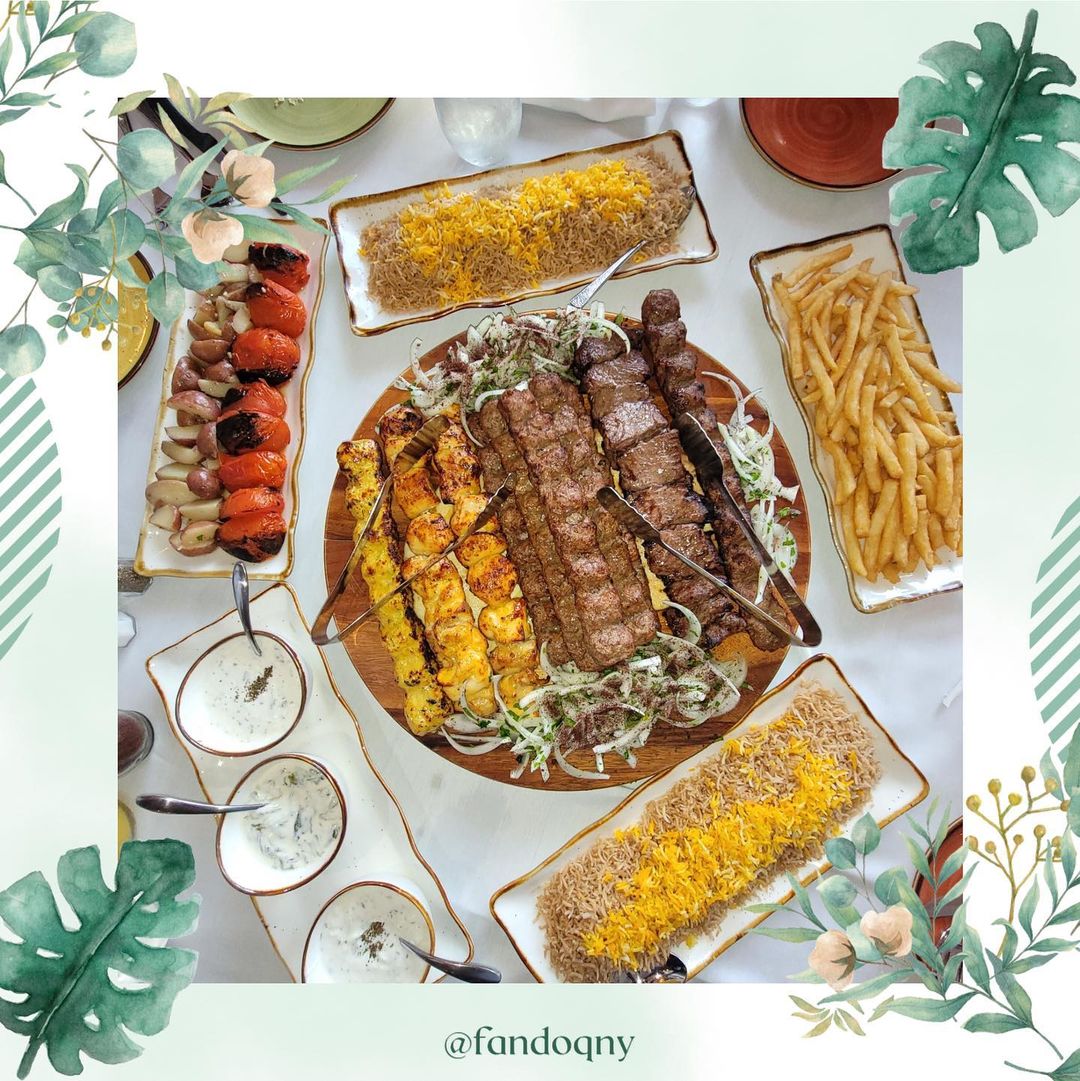
Persian main courses divide broadly into two categories: kababs (grilled meats) and khoresh (stews). Both are typically served with Persian saffron rice.
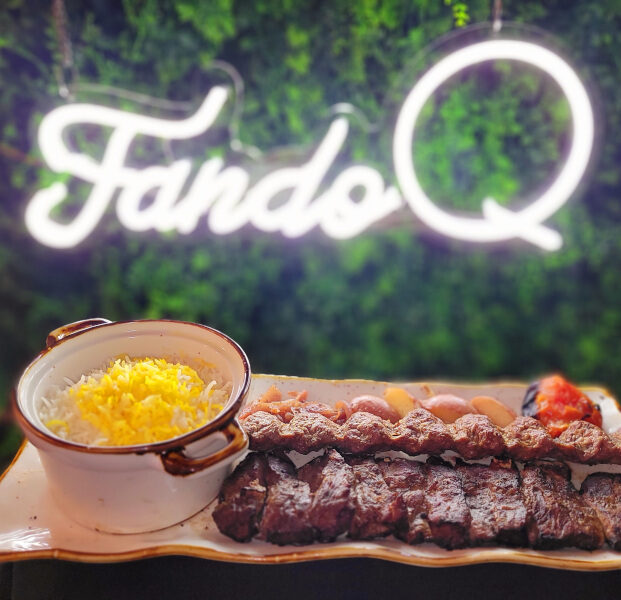
Kababs are what most first-timers gravitate toward, and rightly so — they are approachable, they showcase Persian spicing and technique, and they are simply excellent. Key kababs to know:
- Kubideh — ground beef or lamb mixed with grated onion and spices, formed onto wide flat skewers and grilled. It is the most beloved Persian kabab, the one every Persian grew up eating. Our recipe guide gives you a sense of what goes into it.
- Barg — thinly sliced beef tenderloin marinated in saffron and onion, grilled quickly over high heat. More refined than Kubideh, more expensive, extraordinary when done right.
- Joojeh — chicken marinated in saffron, lemon, and onion. Golden, fragrant, and the most popular kabab for first-timers because it is familiar enough to be approachable and Persian enough to be exciting.
- Shrimp Kabab — for those who prefer seafood. Marinated in Persian spices and chargrilled.
Stews (khoresh) are for your second visit, or for adventurous first-timers. The Ghormeh Sabzi — a slow-cooked herb stew with kidney beans and dried limes — is considered by many Persians to be the national dish. It is deeply herby, tangy, and unlike anything in Western cooking. Fesenjan — pomegranate walnut stew — is the other great choice: dark, rich, complex, and completely unforgettable.
Rice: The Heart of the Meal
Persian rice is not an afterthought. It is a centrepiece. The dam method of steaming produces grains that are individually fluffy and separate — no stickiness, no clumping — with a golden crispy crust at the bottom of the pot called tahdig (literally “bottom of the pot”). Tahdig is the most coveted part of the meal. When the server places the rice on the table and breaks off a piece of the golden crust, reach for it. It is the Persian cook’s gift to the table.
Our complete guide to making tahdig explains the technique in detail if you want to try it at home.
Desserts and Tea
Persian dessert is gentle and aromatic rather than heavy and sweet. Bastani — saffron and rose water ice cream — is the great Persian dessert. It is delicate, floral, and unlike any ice cream in Western tradition. Follow it with Persian tea, served strong and amber in a small glass, with rock candy on the side.
Dietary Notes: Halal, Gluten, and Allergies
Persian cuisine at FandoQ is fully halal — our meat is halal-certified throughout. If you are curious about what halal means and why it matters, our Complete Guide to Halal Dining on Long Island covers everything in detail.
Persian food is naturally quite gluten-friendly. Rice is the primary starch, most stews are thickened by reduction rather than flour, and many dishes are inherently gluten-free. If you have a gluten intolerance, mention it to your server — we will guide you to the right dishes.
Vegetarians will find several strong options: the mezze and dips, herb rice dishes, and some stews are fully plant-based or can be adapted. Persian cuisine has a long vegetarian tradition rooted in Nowrouz seasonal cooking and everyday home cooking — it is not an afterthought.
A Few Helpful Notes
Order more than you think you need. Persian meals are meant to be abundant. If you order one dish each and eat it individually, you are not having the Persian experience. Order to share. The table should feel full.
Bread arrives early. Use it with the starters. Do not fill up on bread — the rice and stews are coming and they are worth saving room for.
Ask the server. Any good Persian restaurant will happily explain dishes, suggest pairings, and adjust for preferences. We want you to enjoy the meal, not guess your way through it.
Your First Visit to FandoQ NY
FandoQ NY at 1610 Old Country Road in Westbury is the perfect place for your introduction to Persian cuisine. Our menu covers the full range — kababs, stews, rice dishes, mezze, and desserts — in an environment that is warm, welcoming, and right for a first-timer. Our staff know the menu thoroughly and love talking about it.
Browse our appetizers and main courses ahead of time if you like, or come in and let us guide you. Either way, you are about to discover something genuinely special.
(516) 279-4551 — Open Mon–Thu from 3 PM, Fri–Sun from 1 PM.